Batmobile
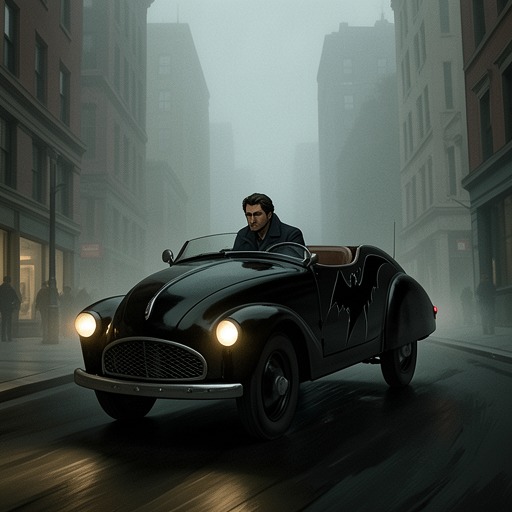
Batman the Dark Knight Returns 10th Anniversary Edition HardcoverThe Batmobile is the principal vehicle of Bruce Wayne / Batman’s renewed campaign in Gotham City, and its significance extends beyond transportation. It carries the physical force of Batman’s return into streets dominated by the Mutant gang, enables rapid intervention when ordinary institutions fail, and makes his reappearance visible as a public fact. Across the narrative, the vehicle stands at the meeting point of aging machinery, political disorder, and heroic identity: it is at once a weapon, a command platform, and a moving emblem of Batman’s refusal to remain retired.
Design and Function
The Batmobile belongs to the technological world that supports Batman’s return after years of retirement. It is presented as a specialized, militarized machine rather than an ordinary car, equipped to survive violent confrontation and to extend Batman’s capabilities beyond what his aging body can provide. Its armor, firepower, and speed turn movement through Gotham City into an active form of intervention: the vehicle does not merely take Batman to danger but helps him enter, withstand, and reshape it.
That function is especially important because Bruce Wayne / Batman is no longer represented as an untouched young hero. The Batmobile compensates for physical limits while preserving the continuity of his identity. It allows an older man to act with the reach and impact associated with his earlier career, making technology part of the story’s argument that retirement has not erased the capacity for resistance. The machine therefore operates as a practical extension of Batman’s body and as evidence that his return depends on an assemblage of human endurance, engineering, weapons, and information.
The Vehicle in Batman’s Return
When Batman resumes activity, the Batmobile helps transform an individual decision into a sustained campaign. Its appearance accompanies the reentry of Batman into Gotham City’s deteriorating public life, where the Mutant gang’s violence exposes the weakness of established authority. The vehicle gives Batman the mobility required to confront threats across the city rather than treating crime as a series of isolated encounters, and its presence reinforces the scale of the crisis confronting him.
The Batmobile also changes the visibility of Batman’s actions. A retired Bruce Wayne can remain a private figure, but the Batmobile announces that an organized force has returned to the streets. Its movement through Gotham City makes Batman’s intervention legible to criminals, police, and civilians alike. In this sense, the vehicle is part of the symbolic infrastructure of Batman’s Return: it carries not only a fighter but a recognizable sign that the old order is being challenged by a new, uncompromising authority.
Escalation and Public Conflict
As Batman’s conflict with the Mutant gang intensifies, the Batmobile functions as a force multiplier. It supports Batman’s direct confrontations and helps him operate against opponents who possess numbers and territorial control. The vehicle’s military character reflects the escalation of Gotham City’s disorder: the city’s emergency is no longer met by ordinary patrols or isolated acts of policing, but by increasingly organized and forceful intervention.
This escalation creates an important tension. The Batmobile is designed to protect Batman and overwhelm opposition, yet its very presence places him within the logic of urban warfare. Batman’s methods remain tied to his personal code, including the principle that he does not kill, but the machine surrounds that restraint with overwhelming force. The result is a recurring contrast between an ethical limit maintained by the driver and a vehicle whose armor and weaponry make the conflict appear larger, harsher, and more political than a conventional crime-fighting encounter.
The Batmobile’s role is therefore not purely instrumental. It helps convert Batman’s private trauma and determination into a collective spectacle. The vehicle’s capacity to enter contested spaces, carry equipment, and sustain operations supports the broader mobilization associated with Batman’s confrontation with the Mutant Leader and the later effort to restore order in Gotham City. Its technology becomes one resource among several through which Batman’s authority is assembled and projected.
Damage, Cost, and Transition
The Batmobile’s repeated use also exposes the material cost of Batman’s return. The vehicle can be damaged, exhausted, or rendered inadequate by the scale of the forces arrayed against Batman. Such vulnerability matters because it prevents the machine from functioning as an effortless solution. It remains powerful, but it is still subject to impact, attrition, and the consequences of escalation. The vehicle’s condition consequently parallels Batman’s own physical decline: both can continue to operate, but neither can do so without paying for every extension of the campaign.
By the later stages of the story, the Batmobile’s importance is placed within a changing structure of resistance. Batman’s work increasingly involves allies, public disorder, and the emergence of the Sons of Batman, so the vehicle no longer represents the entire movement by itself. Its earlier association with the solitary returning hero gives way to a broader network in which people, weapons, vehicles, symbols, and leadership all contribute to political action. The Batmobile remains a powerful instrument, but its meaning shifts from being the emblem of one man’s return to being one component of a collective struggle over Gotham City’s future.
Narrative Significance
The Batmobile gives concrete form to the contradiction at the center of Batman’s return. Bruce Wayne / Batman is aging, yet the machine permits the continuation of a role that seems to belong to an earlier era. It preserves identity through technological continuity while simultaneously revealing that continuity as costly and unstable. The vehicle makes Batman’s renewed power visible, but its militarization also shows how far Gotham City has moved from the conditions in which ordinary heroics might have been sufficient.
As a recurring object, the Batmobile binds private memory to public consequence. It is drawn from Batman’s hidden resources, but it repeatedly appears amid Gotham City’s visible emergencies. It carries the past into the present, turning nostalgia into action and action into escalation. Its damaged or limited condition prevents a simple fantasy of invulnerability, while its continued use affirms that Batman’s return is not a single dramatic gesture but an extended material undertaking whose final direction leads beyond the isolated vehicle and toward the organized succession of resistance.